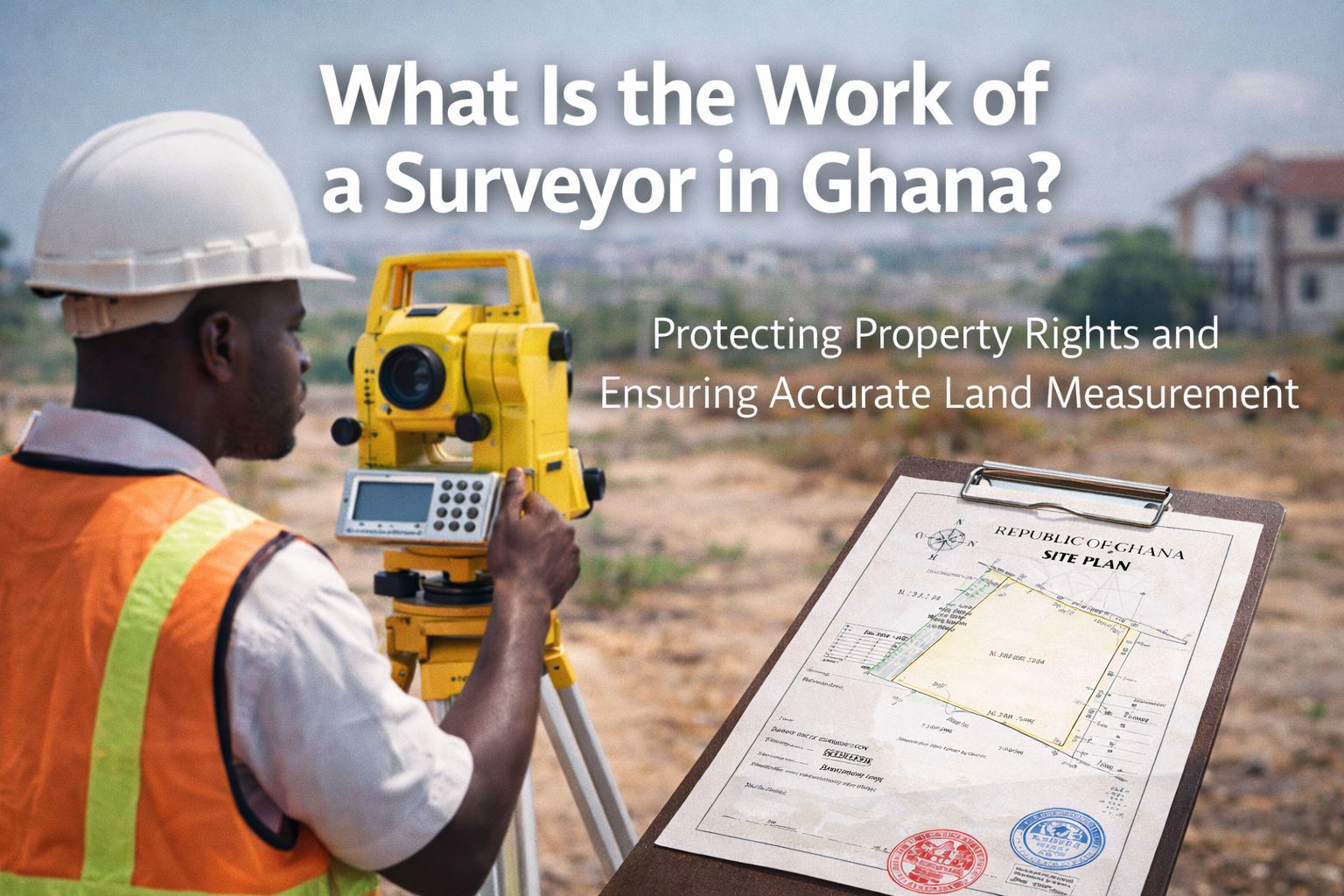
If you are buying land, registering property, or starting a construction project, you may wonder: what is the work of surveyor in Ghana? Understanding what is the work of surveyor in Ghana is essential because surveyors play a critical role in protecting property ownership, preventing land disputes, and ensuring proper development.
In simple terms, the answer to what is the work of surveyor in Ghana is this: a surveyor measures, maps, and defines land boundaries accurately and legally.
But their responsibilities go far beyond just measuring land.
1. Measuring and Mapping Land Boundaries
The most important part of what is the work of surveyor in Ghana involves determining the exact boundaries of a piece of land. Surveyors use specialized equipment to measure land and produce accurate site plans.
Without proper boundary measurements, two properties can overlap, which often leads to disputes. That is why understanding what is the work of surveyor in Ghana is crucial before buying land.
Surveyors ensure:
- Correct plot dimensions
- Clear boundary demarcation
- Accurate land size calculations
- Proper placement of boundary pillars
2. Preparing Site Plans
Another key aspect of what is the work of surveyor in Ghana is preparing official site plans. A site plan is a detailed drawing that shows the land’s measurements, orientation, and location.
This document is required when registering land at the Lands Commission Ghana. Without a properly prepared site plan, land registration may be delayed or rejected.
So when people ask, what is the work of surveyor in Ghana, preparing legally acceptable site plans is a major part of the answer.
3. Assisting in Land Registration
If you are processing an indenture or land title, you will need a surveyor’s input. Part of what is the work of surveyor in Ghana involves submitting survey documents for verification and approval during the registration process.
Surveyors work closely with the Lands Commission Ghana to ensure that land coordinates match official records.
This helps prevent:
- Double sales
- Encroachment
- Registration errors
Clearly, what is the work of surveyor in Ghana directly impacts whether your land becomes legally recognized.
4. Preventing Land Disputes
Land litigation is common in Ghana. Many of these disputes arise because land was not properly surveyed.
A major part of what is the work of surveyor in Ghana is protecting landowners from conflict. By accurately identifying land boundaries, surveyors reduce the risk of:
- Overlapping plots
- Family land disagreements
- Encroachment by neighbors
When buyers ignore professional surveying, they increase their legal risks. That is why understanding what is the work of surveyor in Ghana can save you money and stress in the future.
5. Setting Out Buildings for Construction
Before construction begins, a surveyor marks the exact position where the building should sit on the land. This process is called “setting out.”
An important function in what is the work of surveyor in Ghana is ensuring that:
- Buildings follow approved layouts
- Structures do not cross boundaries
- Developments comply with planning regulations
If a building is wrongly positioned, it may be demolished or require costly corrections. This shows again why what is the work of surveyor in Ghana is essential for developers and homeowners.
6. Land Subdivision and Layout Planning
When landowners want to divide a large parcel into smaller plots for sale, a surveyor is required.
Another major responsibility in what is the work of surveyor in Ghana is designing land layouts and subdivisions. Surveyors ensure:
- Equal plot distribution
- Proper road access
- Compliance with local planning rules
Without professional subdivision planning, plots may become difficult to register or sell.
7. Conducting Topographic Surveys
Topographic surveys analyze the physical features of land, including elevation, slopes, drainage, and natural features.
This technical aspect of what is the work of surveyor in Ghana is especially important for:
- Estate development
- Road construction
- Large-scale projects
Understanding the land’s physical condition helps engineers and architects design safe and stable structures.
8. Using Modern Technology in Surveying
Modern surveying in Ghana involves advanced tools such as GPS systems and digital mapping equipment.
Today, part of what is the work of surveyor in Ghana includes:
- Using satellite positioning systems
- Producing digital survey maps
- Providing coordinate-based verification
Technology has made the work more precise and reduced errors in land measurements.
Who Can Work as a Surveyor in Ghana?
To legally practice, a surveyor must be properly trained and recognized by relevant authorities. It is important to hire a licensed professional to ensure your documents are valid and accepted by the Lands Commission Ghana.
Hiring unqualified individuals can result in fake site plans, rejected registrations, and legal complications.
Why You Should Never Skip a Surveyor
If you are buying land, you might try to save money by skipping professional surveying. That is risky.
Understanding what is the work of surveyor in Ghana helps you see that a surveyor protects your investment by:
- Confirming the land truly exists
- Verifying accurate measurements
- Preventing future legal disputes
- Supporting successful registration
- Guiding proper construction
The cost of hiring a surveyor is small compared to the potential loss from land fraud or litigation.
Our Parting Words
So, what is the work of surveyor in Ghana?
The work of a surveyor in Ghana involves measuring land, preparing site plans, preventing disputes, assisting in land registration, guiding construction, and ensuring accurate property boundaries.
In Ghana’s real estate environment, where land issues can become complex, surveyors act as protectors of property rights. Whether you are buying land, building a home, or developing an estate, understanding what is the work of surveyor in Ghana is one of the smartest steps you can take.
Before making any property payment, always consult a qualified surveyor. It could be the decision that protects your investment for generations.
Disclaimer
This article is for informational and educational purposes only and does not constitute legal, technical, or professional surveying advice. Land measurement, boundary verification, and registration processes may vary depending on location and regulatory requirements. Readers are encouraged to consult a licensed surveyor and verify documentation with the Lands Commission Ghana before making any property-related decisions. Autonaba.com is not responsible for actions taken based on this content.