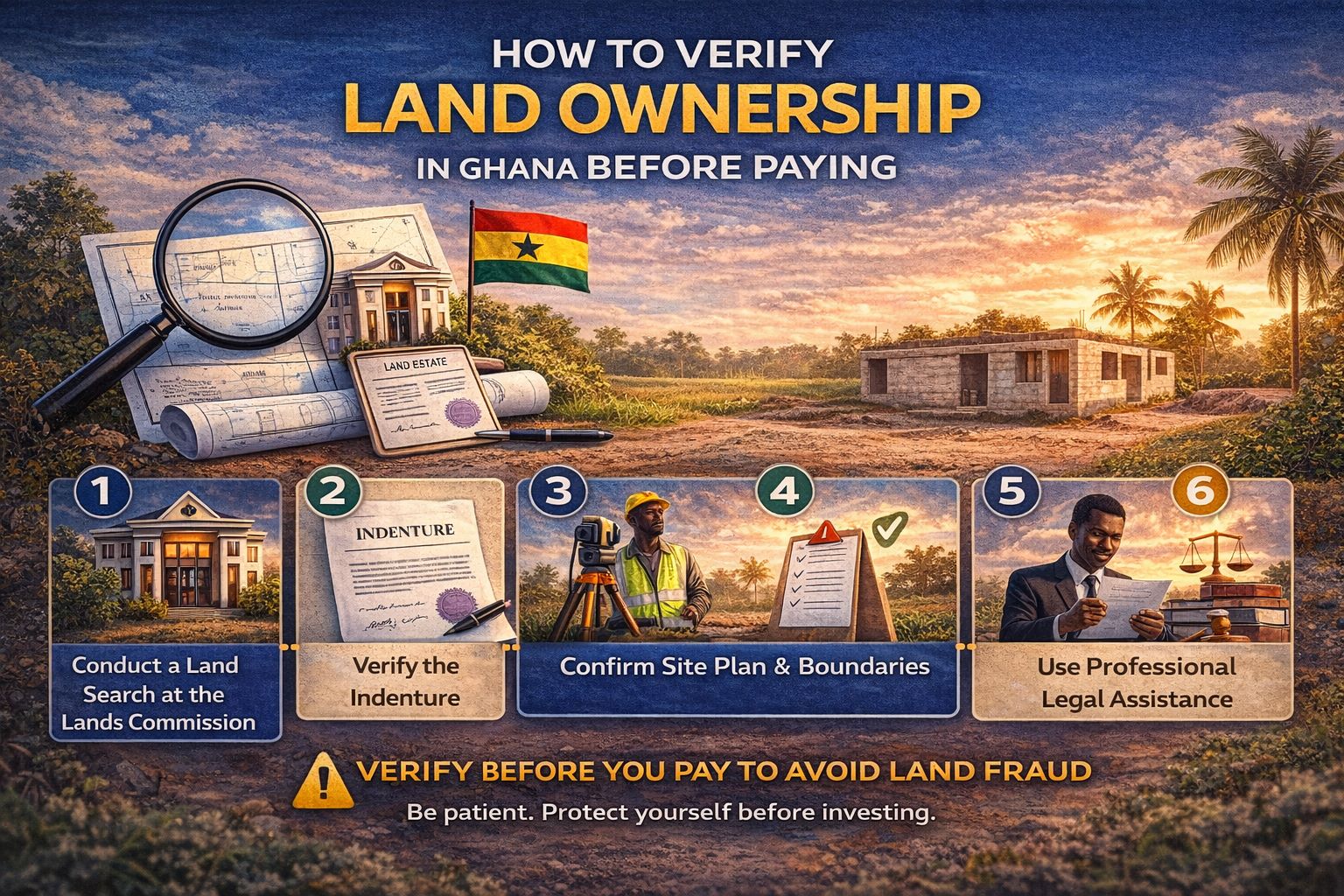
Buying land in Ghana is one of the most significant financial decisions you can make. Land investment can generate long-term value, but it also carries serious risks if ownership is not properly verified.
Cases of double sales, forged documents, and disputed family lands remain common in the property market. Paying for land without due diligence can lead to legal battles and financial loss.
To protect yourself, verification must come before payment — not after.
Here is a complete guide on how to verify land ownership in Ghana and ensure your investment is secure.
Why Land Verification Matters
Land disputes in Ghana often arise from:
- Multiple sales of the same land
- Family or stool land disagreements
- Fake documentation
- Unregistered transactions
- Boundary conflicts
Even if a seller appears legitimate, documentation must be independently confirmed.
Verification reduces risk and builds confidence in the transaction.
Step 1: Conduct a Land Search at the Lands Commission
The most important verification step is a land search at the Lands Commission.
The Lands Commission maintains records of registered land titles and ownership details.
A land search will reveal:
✔ Registered owner information
✔ Existing encumbrances (claims or disputes)
✔ Land title status
✔ Registration validity
If the seller’s name does not match records, proceed with extreme caution.
How to do it:
- Visit the Lands Commission office
- Submit a search application
- Provide site plan and location details
- Pay the required fee
- Obtain a search report
This document is critical for confirming legal ownership.
Step 2: Verify the Indenture
The indenture is the legal document that transfers land ownership.
Check:
✔ Seller’s name matches the indenture
✔ Document is properly stamped
✔ Signatures are authentic
✔ Description matches site details
A missing or incomplete indenture is a major red flag.
Never rely on photocopies alone. Request original documents for inspection.
Step 3: Confirm the Site Plan
A site plan defines the exact boundaries of the land.
It should include:
- Survey coordinates
- Plot dimensions
- Location reference
- Boundary markers
A professional surveyor can verify whether the site plan corresponds with physical boundaries.
Boundary disputes are common in Ghana, so this step is essential.
Step 4: Check for Encumbrances
Encumbrances are legal claims or restrictions on the land.
Examples include:
- Mortgages
- Court disputes
- Government acquisitions
- Outstanding debts
If an encumbrance exists, the seller may not have full authority to transfer ownership.
The land search report from the Lands Commission will reveal this information.
Do not proceed until issues are resolved. Using AI to detect real estate fraud.
Step 5: Confirm Stool or Family Land Rights
Much land in Ghana belongs to stools or families rather than individuals.
This introduces additional complexity.
For stool or family land:
✔ Verify approval from traditional authorities
✔ Confirm proper documentation
✔ Ensure collective agreement among family representatives
✔ Obtain written authorization
Transactions involving communal land require extra diligence.
Legal documentation alone may not be sufficient.
Step 6: Use Professional Legal Assistance
Real estate transactions involve legal details that require expertise.
Hiring a property lawyer can:
- Review documents
- Identify risks
- Draft agreements
- Ensure compliance
- Protect your interests
Legal fees are far less expensive than litigation costs.
Consider it an investment in security.
Step 7: Inspect the Land Physically
Physical inspection complements document verification.
During inspection:
- Confirm boundaries
- Look for markers
- Check accessibility
- Assess environmental factors
- Speak with neighbors
Neighbors often know local history and disputes.
Their insights can reveal important information.
How Autonaba Uses AI to Match Buyers with Properties.
Step 8: Avoid Cash Transactions Without Documentation
Never pay for land based on verbal agreements.
Payments should only occur after:
✔ Verification is complete
✔ Documentation is signed
✔ Legal agreements are in place
✔ Receipts are issued
Informal transactions create vulnerability.
Proper documentation protects both buyer and seller.
Step 9: Use Trusted Platforms for Listings
Digital property platforms help buyers compare listings and access verified opportunities.
Platforms like Autonaba provide:
- Structured property information
- Market comparisons
- Verified listings
- Investment insights
However, even with digital platforms, personal verification remains necessary.
Technology supports due diligence — it does not replace it.
Step 10: Be Patient and Thorough
Rushing a land purchase increases risk.
Take time to:
- Verify documents
- Consult professionals
- Compare options
- Ask questions
A good investment is worth careful preparation.
Impatience often leads to costly mistakes.
Common Warning Signs of Fraud
Watch for these red flags:
❌ Prices far below market value
❌ Reluctance to provide documents
❌ Inconsistent ownership claims
❌ Pressure to pay quickly
❌ Missing registration details
If something feels wrong, investigate further.
Trust your instincts and rely on facts.
Final Thoughts
Land ownership verification in Ghana is not optional — it is essential.
The process involves:
- Land searches
- Document checks
- Legal reviews
- Physical inspection
- Professional guidance
Skipping steps increases risk.
With proper due diligence, land investment can be secure and profitable.
Real estate success comes from informed decisions, not assumptions.
By verifying ownership before payment, you protect your investment and future financial security.
Disclaimer
This article is for informational purposes only and does not constitute legal or financial advice. Real estate transactions involve legal complexities, and investors should consult qualified professionals before making decisions. Autonaba Team do not guarantee property ownership outcomes or investment returns. Conduct independent due diligence and verify all documentation with appropriate authorities.