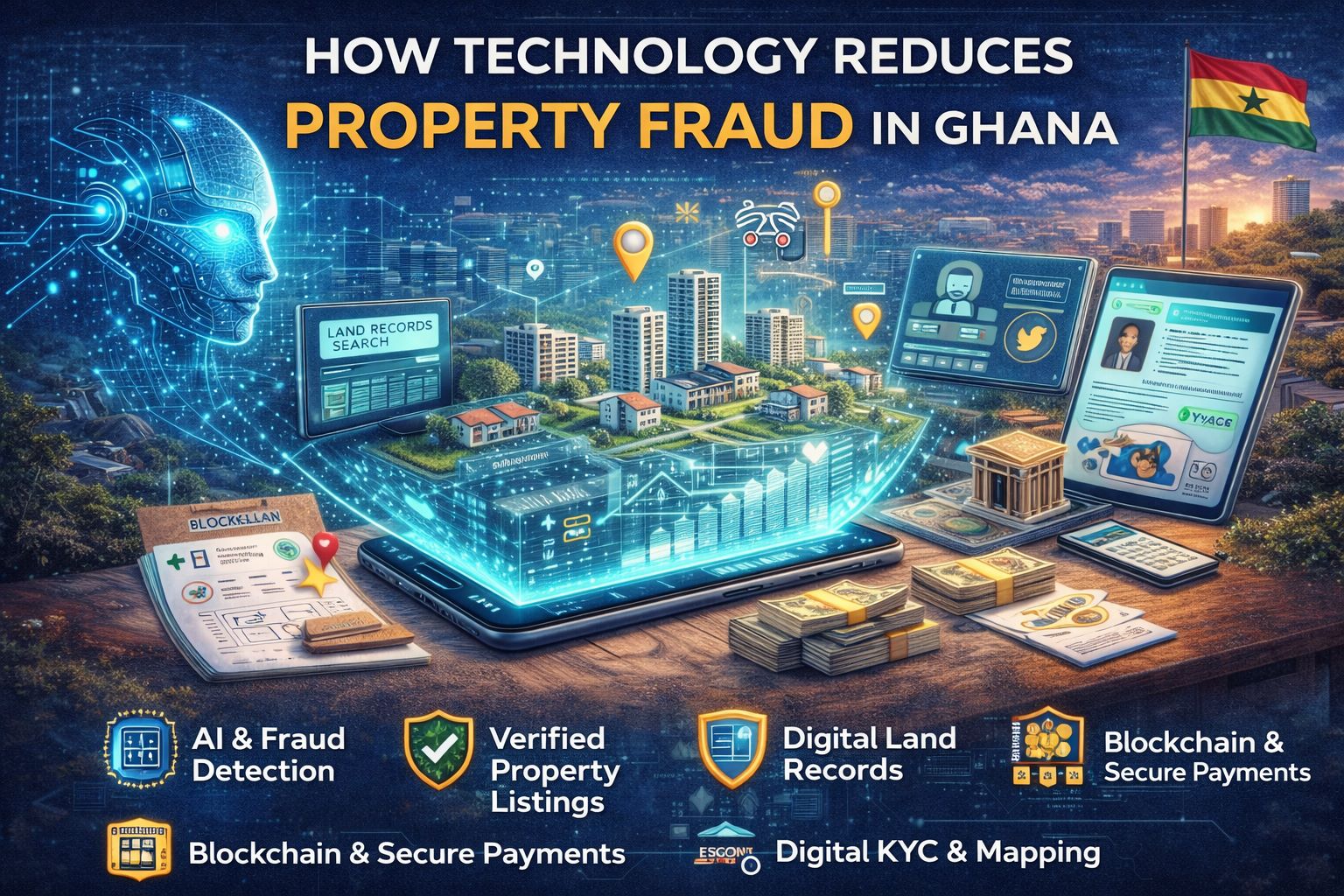
Property fraud has long been one of the biggest risks in Ghana’s real estate market. From double land sales to forged indentures and fake agents, many buyers have lost thousands of cedis due to poor verification and lack of transparency.
Today, however, technology is reducing property fraud in powerful ways. Through digital verification systems, artificial intelligence, blockchain tracking, and centralized databases, real estate transactions are becoming safer, smarter, and more transparent.
If you are buying land, investing in real estate, or developing property in Ghana, understanding how technology reduces property fraud can protect your investment and give you confidence.
Understanding Property Fraud in Ghana
Before exploring solutions, it is important to understand the problem.
Common forms of property fraud in Ghana include:
- Multiple sales of the same land
- Forged land documents
- Fake site plans
- Impersonation of property owners
- Unregistered agents posing as brokers
- Hidden encumbrances on property
Historically, property transactions relied heavily on manual paperwork and verbal agreements. This created loopholes for fraudsters to exploit.
But technology is changing that.
Understanding Property Fraud in Ghana
Before exploring solutions, it is important to understand the problem.
Common forms of property fraud in Ghana include:
- Multiple sales of the same land
- Forged land documents
- Fake site plans
- Impersonation of property owners
- Unregistered agents posing as brokers
- Hidden encumbrances on property
Historically, property transactions relied heavily on manual paperwork and verbal agreements. This created loopholes for fraudsters to exploit.
But technology is changing that.
2. AI-Powered Property Verification Systems
Artificial Intelligence (AI) is becoming a major force in property fraud prevention.
AI systems can:
- Detect duplicate property listings
- Flag suspicious pricing patterns
- Identify unusual transaction behavior
- Cross-reference ownership data
- Analyze documentation inconsistencies
For example, if a plot of land appears under multiple sellers, an AI-powered platform can flag the inconsistency instantly.
This proactive detection significantly reduces real estate scams in Ghana.
AI also helps platforms build credibility by verifying listings before publishing them.
3. Blockchain and Smart Contracts
Although still emerging in Ghana, blockchain technology has the potential to revolutionize secure property transactions.
Blockchain creates an immutable digital ledger that records transactions permanently. Once ownership is recorded on a blockchain system, it cannot be altered without trace.
This prevents:
- Document forgery
- Title manipulation
- Unauthorized changes
Smart contracts can also automate payments, ensuring funds are only released when agreed conditions are met.
While adoption is still growing, blockchain represents the future of fraud-proof real estate systems.
4. Online Property Marketplaces with Verification Systems
Modern property platforms are playing a major role in reducing property fraud in Ghana.
Unlike informal roadside agents, digital platforms can:
- Require identity verification for agents
- Verify property documentation before listing
- Provide transaction records
- Track user reviews and history
This builds accountability.
A verified digital listing is far safer than responding to random WhatsApp broadcasts or social media posts with no traceability.
Technology introduces transparency — and transparency discourages fraud.
5. Geolocation and Digital Mapping
Another powerful tool in property fraud prevention is digital mapping.
GPS-based systems and geographic information systems (GIS) allow buyers to:
- Confirm land boundaries
- Verify site plans
- Compare coordinates with official survey records
In the past, buyers relied solely on physical landmarks or verbal descriptions.
Now, digital mapping tools can confirm whether a plot overlaps with another registered property.
This reduces:
- Boundary disputes
- Encroachment issues
- Double land sales
Geolocation technology makes land verification more accurate than ever before.
6. Secure Digital Payments and Transaction Trails
Cash payments increase fraud risk. Technology reduces that risk through secure banking systems and traceable digital payments.
When transactions are processed through:
- Bank transfers
- Escrow services
- Secure online platforms
There is a digital trail.
This documentation protects both buyer and seller. It also discourages fraudsters who prefer untraceable cash transactions.
A transparent financial record strengthens secure property transactions.
7. Data Transparency and Market Intelligence
Overpricing is another form of property exploitation.
AI-driven property valuation systems help buyers understand fair market value. When pricing becomes data-driven:
- Sellers cannot easily inflate prices
- Buyers negotiate with confidence
- Market manipulation decreases
Technology reduces information imbalance — one of the biggest causes of property fraud.
When buyers have access to pricing trends, neighborhood data, and property history, scams become easier to detect.
8. Identity Verification and Digital KYC Systems
“Know Your Customer” (KYC) systems are becoming more common in financial and property transactions.
Digital identity verification ensures:
- The seller is who they claim to be
- The buyer is properly documented
- Agents are licensed and traceable
Biometric verification and ID validation systems reduce impersonation fraud.
This strengthens trust within the real estate ecosystem.
Why Technology Is the Future of Fraud Prevention
The key reason technology reduces property fraud is simple: it replaces trust-based systems with verification-based systems.
Instead of relying on:
- Verbal assurances
- Handwritten documents
- Informal agents
Buyers can rely on:
- Verified databases
- AI-powered detection
- Digital land records
- Secure payment trails
As Ghana’s real estate market continues to grow, technology will become essential — not optional.
Our Parting Words
Property fraud remains a real risk in Ghana. However, technology is significantly reducing that risk through digital land registration, AI verification systems, blockchain innovation, secure payment channels, and geolocation mapping.
The future of secure property investment in Ghana depends on digital transparency.
Buyers who leverage technology gain:
Greater protection
Faster verification
Smarter pricing insights
Stronger legal security
In real estate, knowledge protects money.
And today, technology delivers that knowledge faster and more accurately than ever before.
The smarter the system, the safer the investment.